
28/09/26
Winter-Proofing Your London Block

020 3637 7968
info@mihproperty.co.uk020 3637 7968
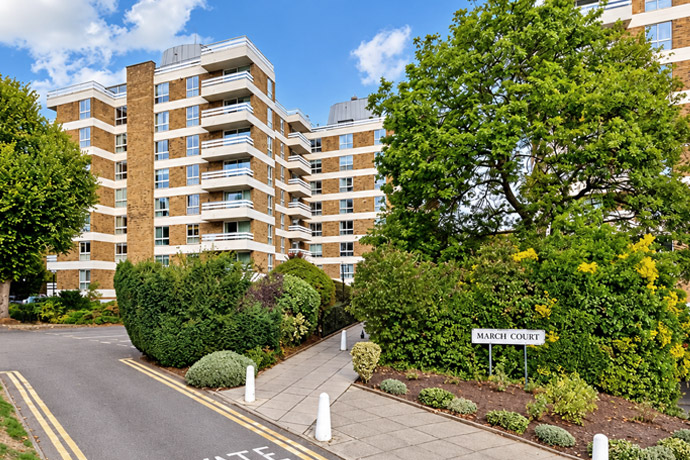
MIH recently assisted in the completion of the Building Assessment Certification for March Court A, B and C, three residential blocks in Richmond-Upon-Thames, London.
In this article we look at what is involved in the Building Assessment Certification process, the pitfalls, and an important case study – with a successful outcome. We summarise how it was achieved, how MIH helped and include a free tip sheet developed by Tim Cullis, the ‘pioneering’ applicant.
A Building Assessment Certificate (BAC) is a formal legal document issued by the Building Safety Regulator (BSR) in England. It demonstrates that a building has been designed, constructed, inspected, and maintained in accordance with safety standards and regulations. Certification helps identify and address hazards such as fire, structural defects, and inadequate emergency measures.
It supports compliance with the Building Safety Act 2022, passed in response to the 2017 Grenfell Tower fire, which precipitated a much-needed overhaul to building safety regulations. Its focus is to consider the safety of residents – particularly those in blocks, high-rise and higher-risk buildings with e.g. cladding.
In England, a block of residential flats generally falls within the higher-risk building (HRB) regime if it has:
The fire-related aspects are to meet the requirement of the Regulatory Reform (Fire Safety) Order 2005. The FSO 2005 was vastly strengthened by three sets of legislation that were passed post Grenfell.
For these buildings, the Principal Accountable Person (PAP) has a legal duty to provide documentation to support a BAC. The PAP is typically the building’s freeholder, building owner, or a Resident Management Company (RMC) or Right to Manage (RTM) entity that holds responsibility for the building’s structure and exterior. The Responsible Person (RP) remains responsible for fire safety under the FSO.
You cannot apply voluntarily for a BAC, you must wait for the BSR to invite your building based on risk-prioritised criteria (such as height, cladding type, and structural age). The process for completing the application requires the acquisition and collation of key documents to create a Golden Thread that holds all the information about the history and upkeep of your building.
However, it is important to be aware that once invited to apply for your BAC, you have just 28 days to provide this information. This is no mean feat, and most blocks would not be able to comply with this timeframe without making a solid head start in advance of the request.
Building Safety Report
Resident Engagement Strategy
Mandatory Occurrence Reporting Systems
A formal framework used to record and report serious safety incidents and risks concerning structural failure or fire spread in higher-risk buildings directly to the BSR to prevent future accidents and harm.
We interviewed Tim Cullis, a nominated SPOC (Single Point of Contact) for March Court – an HRB that was invited to prepare a BAC in 2024 – with convoluted and challenging consequences. (MIH fulfils the role of Responsible Person (RP) in this building.)
What is the nature of the property at March Court?
“The three blocks of March Court are each HRBs (higher-risk buildings) both in terms of number of storeys (7 or more) and the height of the floor level of the highest occupied storey (18 metres or more) and as such are subject to the Building Safety Act 2022. They do not have cladding.
The overall development is known as Warwick Drive Estate, with a residential management company (RMC) referred to as WDMC. It is controlled by the 108 leasehold flat owners in March Court and 18 freehold house owners in Warwick Drive.”
This provides the background and definition of the properties involved in the application. Tim himself is a resident freeholder and elected RMC Director.
Do you have any qualifications that have assisted you in your role as SPOC and the application for the Building Assessment Certificate?
“I have over 20 years recent experience of directing three RMCs. I started almost fifty years ago in accountancy, then moved to computing in the mid 1970s, developing and implementing IT systems. Of more relevance, however, has been my later experience of technical authoring highly complex matters together with wordsmithing, graphic design and presentation skills. I always intensively research subjects and have been described as ‘forensic’.”
Tim’s background and skillset have been particularly useful in negotiating the complexities of the BAC application. Nevertheless, he and his fellow residents encountered all manner of costly pitfalls and complications in attempting to fulfil the requirements.
What kind of difficulties did you encounter?
“It is a complete minefield, primarily due to a total lack of structured training materials, incompetent consultants and a mire of legislation.”
“You are going to need to get outside assistance for much of the work involved in complying with the legislation, and without funds at your disposal you won’t be able to proceed. How much you need depends on your buildings and location, but if you are going to use consultants for most of the work you need to think in terms of £60,000 to £90,000 over the next couple of years.”
“The Safety Case Report: The ideal way to prepare the SCR is to firstly build your depository of ‘Golden Thread’ information, then to take snapshot aspects of that data, together with risk identification, matrices of consequences, and moderation strategies, to build the Building Safety Case [BSC]. Then to summarise the BSC in a short 30 – 40 page SCR.”
“Our initial quote for the SCR was over £56,000, though that did include some of the tasks described above. The company we eventually used cost £18,000. However, faced with the likelihood that our BAC application would fail (and would incur extra Regulation assessment costs), I developed our own SCR which together with painstaking research took nearly 120 hours.
Tim also featured in a piece in the Time newspaper alongside Andy Roe, chair of the Building Safety regulator.
“
Getting the right safety reports is a minefield. Consultants charged Tim Cullis and his neighbours in Barnes, southwest London, almost £25,000 for two reports written so poorly that he rewrote them. Then they lost £6,800 because the BSR found they had three buildings, not one, so they had to reapply. “I have put in over 800 hours of work,” says Cullis, 75, a director of the residents’ body. “It’s a bureaucratic nightmare.”
The Times – Saturday May 09, 2026
Given the issues that you faced, what recommendations might you make to others in the same situation and how did MIH help?
“Part of the success criteria for other RMCs is to have a reactive Managing Agent (MA) to help push the process through. In our case, MIH worked with the SCR company to try to find historic information that, of course, was missing on a 60-year old building.”
“I have to say, that WDMC has been fortunate to have an extremely committed MA that has allocated hard-working resources to us as part of their in-house expertise building, and that we have been swimming through the treacle together.”
Following this interview, we are delighted to share that we have now received confirmation of success regarding the BAC application for March Court.
“
The MDT is happy with your undertakings regarding the additions to the Safety Case Report and I am pleased to let you know that all three of us have unanimously agreed to award a Building Assessment Certificate for all three blocks.”
The Building Safety Regulator
Tim has subsequently provided detailed feedback to the BSR Chairman and BSR Chief Executive officer and contributed to the House of Lords enquiry to try to bring change to the process to make it accessible and attainable for others in the same shoes. Tim’s recommendation:
“Given the importance of the BSA programme, there should be room in BSR’s budget for a well-developed education programme to help demystify the whole safety management issue for RMCs. This would help them get their safety management procedures up and running in preparation for the coming tranches of BSA application invitations that will be issued in the next few years.”
Resident-led Organisations with Higher-Risk Buildings
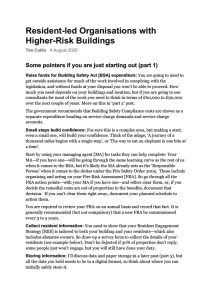
Tim has very kindly agreed to share his distilled notes and recommendations for others facing BAC applications. Please click the image to download the pdf.
Ultimately, certification helps create safer, more compliant, and trustworthy buildings. However, most PAPs and those responsible for fulfilling the BAC are ill-prepared for the amount of work or the likely fees involved with the application.
If you haven’t yet been invited to apply for your BAC then we strongly advise collating your documents now, while you have time, in preparation for the application.
If you would like help with this MIH is now well placed to provide support and guidance having gone through the process in great detail with a successful outcome.
Sources